
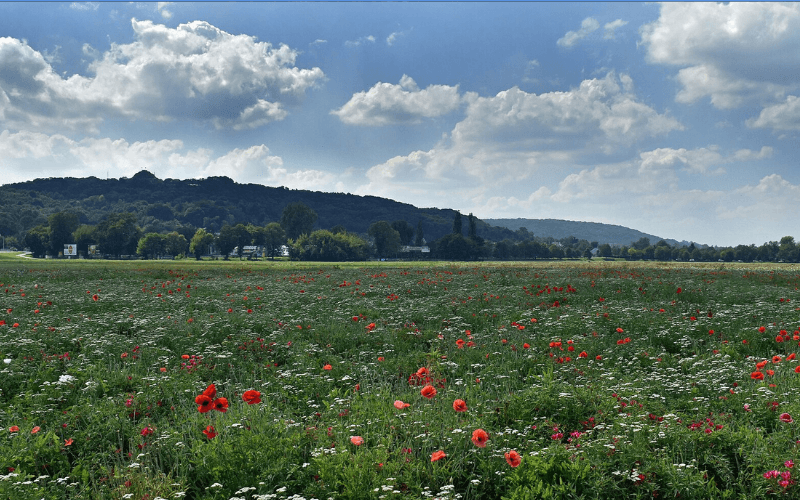
Błonia — The Great Meadow in the Heart of Kraków
A vast green space where history, legend and everyday life meet
Some cities have managed to preserve large green areas almost in the very center. New York has its iconic Central Park, Munich has the Theresienwiese, home to the annual Oktoberfest (ironically held every September). And while New York’s park is—like everything there—much larger, Kraków’s Błonia surpass the Munich meadow by several hectares. This raises a natural question: how did such a huge open space survive centuries of urban development, political turmoil and the ambitions of countless builders?
From medieval pasture to a symbol of Kraków
The story of Błonia reaches back to the 12th century and the era of the Crusades. Jaksa Gryfita—an intriguing and somewhat mysterious nobleman—decided, before departing for the Holy Land, to secure divine favor. Donations were never refused, so he gifted the Norbertine Sisters (the Zwierzyniec Nuns) a large pasture between the villages of Zwierzyniec and Łobzów. This simple act of piety became the foundation of one of Kraków’s most remarkable landscapes.
Two centuries later, the sisters exchanged the land with the city for a townhouse on Floriańska Street. Fate was unkind: the building soon burned down, and without fire insurance, the nuns spent decades trying to reverse the deal. Court cases dragged on, involving kings and popes, but ultimately failed. The meadow remained in the hands of Kraków’s citizens.
Until the early 20th century, Błonia were a floodplain. The nearby Rudawa River regularly turned the area into a marsh for months at a time. The catastrophic flood of 1903—when people could literally paddle boats across the meadow—forced the city to act. A major drainage project transformed Błonia into the open, walkable space we know today.
The northern part of the meadow hosted an agricultural‑industrial exhibition in the late 19th century, later becoming Jordan Park. Other attempts to build on Błonia appeared throughout history: the Germans during World War II, the communists after the war. All failed—thanks to residents’ protests and, finally, the decisive action of the Provincial Heritage Conservator, who in 2000 placed Błonia under legal protection as a historic spatial layout.
A stage for great events
Błonia have witnessed moments that shaped Polish history. In the 13th century, Bishop Prandota welcomed envoys from Assisi carrying the papal bull of canonization for St. Stanislaus. During the Duchy of Warsaw, military parades celebrated Napoleon Bonaparte’s name day, organized by Prince Józef Poniatowski and General Henryk Dąbrowski—the same Dąbrowski from our national anthem.
In the mid‑19th century, Tsar Nicholas I—crowned King of Poland, a fact many prefer to forget—reviewed his troops here before marching to Hungary to suppress the uprising led in part by General Józef Bem.
In 1910, the first airplane in Kraków, a Bleriot piloted by Otto Hieronimus, took off from Błonia. That same year, residents gathered here to watch Halley’s Comet.
On 4 August 1914, the First Cadre Company under Józef Piłsudski departed from nearby Oleandry, becoming the nucleus of the Polish army.
In modern times, millions gathered on Błonia during papal visits—around 2.5 million in 2002. Popes Benedict XVI and Francis also celebrated Mass here. Euro 2012 fan zones, concerts by Dżem or Celine Dion, and countless cultural events have made Błonia not only a historical landmark but also a living part of Kraków’s everyday rhythm.
Experience Błonia with a local guide
Would you like to explore this part of Kraków with me? https://krakow-tour.pl/kontakt/
Fot. Zygmunt Put from Wikipedia