
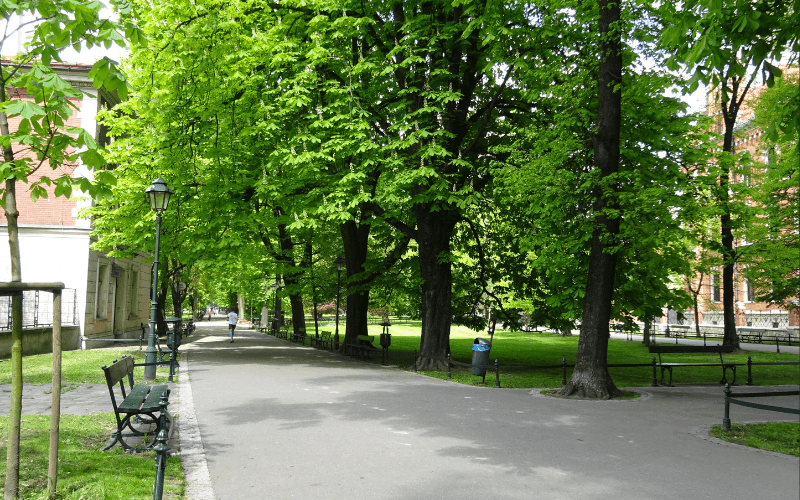
Planty Park – The Green Ring Around Kraków’s Old Town
Planty Park is one of Kraków’s most distinctive landmarks — a four‑kilometre green belt encircling the entire Old Town. It stands where the city’s medieval fortifications once rose, replacing moats, ramparts and defensive walls with one of the most charming urban parks in Europe.
From Medieval Walls to a City Park
Like many medieval cities, Kraków was surrounded by massive defensive walls, reinforced with a forewall and wide moats. The northern entrance was additionally protected by the Barbican, built over five centuries ago in fear of a potential Ottoman attack. By the early 19th century, however, the walls were militarily obsolete, and maintaining several kilometres of fortifications with 47 towers became too costly for a city whose golden age had long passed. Monument protection and art history were still in their infancy, so demolition seemed inevitable.
Why Planty Exists Today
The complete removal of Kraków’s fortifications was planned — including the northern section that survives today. Only the efforts of Feliks Radwański, a senator of Kraków, saved part of the walls: three towers (Pasamoników, Ciesielska and Stolarska) and the iconic St. Florian’s Gate. According to legend, Radwański argued in vain about the historical value of the walls. What finally convinced the council was his colourful warning: removing the northern section would create strong draughts along Floriańska Street, lifting the skirts of elegant ladies. The argument worked — and the Barbican, the towers and a fragment of the walls survived. Between 1810 and 1814 the remaining fortifications were demolished, the moats filled in and levelled — “planted”, as people said at the time. This is where the name Planty comes from. The newly freed space was transformed into a city park.
Planty Today – Key Facts
Planty covers nearly 22 hectares and stretches for four kilometres around the Old Town, from the foot of Wawel Hill at Straszewskiego Street to the opposite side near St. Gertrude Street. The width of the park varies depending on the former fortifications: the narrowest sections lie near old towers and gates, while the widest appear where complex defensive structures once stood, such as near the Barbican. The park is divided into eight gardens: Dworzec, Barbakan, Florianka, Palace of Art, University, Wawel, Gródek and Stradom. Around 2,200 trees grow here, representing 40 species. The oldest is a majestic plane tree near Wiślna Street.
Monuments in Planty Park
Planty is dotted with monuments commemorating Kraków’s history and culture. The oldest, near the railway station, is the 1874 obelisk dedicated to Florian Straszewski — the creator of Planty, who not only designed the park but also founded a fund for its maintenance, donating 3,000 golden ducats. Walking towards the Barbican, you’ll find the monument to the workers’ riots of 1936, later “Christianised” with a wooden cross after the fall of communism. Further on stands the monument to Bohdan Zaleski, depicting the legendary bard Bojan. Nearby, on a small hill, is the monument to Queen Jadwiga and King Władysław Jagiełło — a copy of the monument to Mieszko and Dobrawa from Poznań Cathedral. You’ll also encounter the monument to Lilia Weneda, a heroine from Juliusz Słowacki’s drama. Near the Palace of Art stands the monument to Artur Grottger, and by Collegium Novum — the monument to Nicolaus Copernicus, the most famous student of Kraków’s medieval university. Close by is an oak tree and a plaque commemorating the arrest of Kraków’s professors in November 1939. Behind Collegium Maius stands the statue of Our Lady of Grace, relocated by the Germans during the occupation. Further along, near the Bishop’s Palace, are the monuments to Grażyna and Litawor, and a fountain‑monument dedicated to Fryderyk Chopin. Closer to Wawel Hill stands the monument to Tadeusz Boy‑Żeleński, one of many Polish intellectuals murdered during the war. Near the seminary, two mathematicians — Stefan Banach and Otton Nikodym — sit together on a bench. The last monument on this side of the Old Town is the sculpture Owls by Bronisław Chromy. On the opposite side of Planty, fewer monuments appear, but one notable example is the statue of Michał Bałucki near the Juliusz Słowacki Theatre. Surprisingly, there is no monument to John Paul II in Planty.
Would you like to explore Planty Park or another part of Kraków with me? Contact: https://krakow-tour.pl/en/contact/
Fot. Mach240390 – Praca własna za Wikipedia