
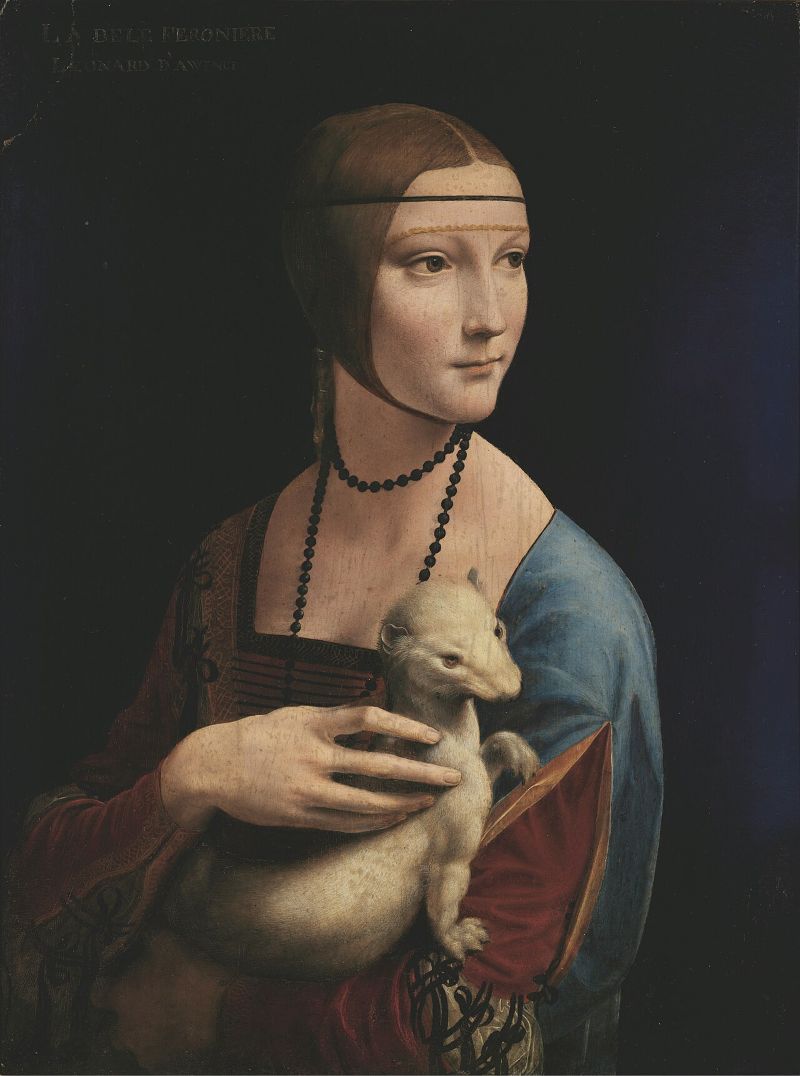
Lady with an Ermine or Lady with a Weasel?
One of the most famous—if not the most famous—paintings in Poland is Lady with an Ermine, also known as Lady with a Weasel, by Leonardo da Vinci.
The painting was created in Italy at the end of the 15th century. It is an oil painting on a walnut panel and measures 40 by 55 centimeters. It is part of the collection of the Czartoryski Museum on Pijarska Street in Kraków, which I wrote about last week.
What does Lady with an Ermine depict?
In the painting we see a young woman holding an animal described as an ermine or a weasel.
The woman is Cecilia Gallerani, the mistress of Ludovico Sforza, Duke of Milan.
Because Cecilia came from a bourgeois family, marriage to the duke was out of the question. At the time the painting was created, Duke Ludovico, for political reasons, married Beatrice d’Este, daughter of the Duke of Ferrara and Modena.
Therefore, it was impossible for da Vinci to portray the duke together with Cecilia in one painting. So what did he do? He painted her with an ermine. But if we look closely at the ermine, we notice muscles that seem more masculine than animal-like, and Cecilia’s hand also appears more masculine than feminine. So what about da Vinci? Was he unable to paint an animal or a hand correctly? Or was he hinting at a deeper meaning?
The ermine—ermellino in Italian—was a nickname of Duke Ludovico. So the ermine is a symbolic representation of him. The ermine was also seen as a symbol of pregnancy. Indeed, at the time the portrait was created, Cecilia was expecting a child, and shortly afterward her and Ludovico’s son, Cesare, was born.
So, answering the question in the title: we are looking at a lady with an ermine, though in fact with a symbolically depicted beloved.
How did Lady with an Ermine end up in Kraków?
Prince Adam Czartoryski, as a young man at the end of the 18th century, traveled through Europe and in sunny Italy came across the opportunity to buy a painting by the famous master Leonardo da Vinci. Since his mother, Izabela Fleming, collected works of art, the prince bought the painting—certainly not a cheap one, as it was known to be by the master’s hand. In this way it arrived in Poland, though not yet in Kraków, but in the Czartoryski estate in Sieniawa near Przemyśl.
The 19th century in Polish history was a time of partitions and the struggle for freedom.
The Czartoryski family took part in the November Uprising of 1831. The uprising against Russia failed, and the estates of those involved were confiscated by the Tsarist authorities. The Czartoryskis fled to Paris, returning to Poland—this time to Kraków—in the 1870s after the turbulent Paris Commune. From then on, Lady with an Ermine could be admired in the Czartoryski Museum in Kraków.
There was one attempted theft, though not the one known from the film Vinci. Hans Frank, the General Governor of German-occupied Poland, tried to escape with the valuable painting as the Soviets approached. Fortunately, the arrested war criminal was hanged in Nuremberg, and Lady with an Ermine safely returned to Kraków.
Want to visit the Czartoryski Museum and see the Lady? Let me know.