
How Kraków survived World War II
Today marks the anniversary of the end of World War II, so I want to write a bit about how it happened that – while Warsaw was leveled by the Germans, Wrocław fought to the bitter end, and large parts of Gdańsk, Poznań, and Szczecin were destroyed – Kraków, at least in terms of its buildings, emerged from the war almost untouched.
Kraków as the Capital of the General Government
At the beginning of the war, when the Germans – as the poet Broniewski wrote – stormed in with their “iron army,” and the promised help from the British and French, expected by romantic fools, of course never arrived, Kraków was abandoned by Polish troops. On 6 September, German forces entered the city. They chose Kraków as the capital of the newly created General Government. This meant a huge number of German officials and soldiers.
This heavy German presence made underground activity, including any kind of uprising, practically impossible in our city. Nearly two‑million‑strong Warsaw was far harder to control, and it had long traditions of underground resistance dating back to the partitions. Kraków had fewer than 290,000 inhabitants, including a few percent of Austrian origin – a legacy of Habsburg rule.
The End of the War and a New Occupier
By winter 1944, Germany’s defeat was certain. The Germans prepared to defend the city: they built bunkers and dug water reservoirs intended to extinguish fires caused by bombings. Most of this work was, of course, done by the city’s inhabitants under coercion.
The Vistula–Oder Offensive of the Red Army – a massive attack along hundreds of kilometers – caused Germany to lose vast territories within two weeks. For the Germans, defending Upper Silesia, with its mines and industry crucial to the war effort, became the priority.
There was fighting around Kraków, and the Soviets bombed the Old Town. Two bombs are known: one hit Wawel, specifically the Báthory Chapel – it reportedly did not explode but still caused significant damage – and another fell near the Collegium Maius, the oldest university building.
The fighting, however, was not very intense. Professor Chwalba gives the number of Soviet soldiers killed as over 800. The losses of the “defenders” were, as usual, several times smaller. On 18 January 1945, the Red Army entered Kraków. Instead of freedom, it brought a new occupier: already that same month, the first trains to Siberia departed, and people were arrested and murdered.
Marshal Konev – Genius, Strategist, and Savior
Soviet propaganda, however, fed us a different story in schools, newspapers, and television. According to the myth that lasted nearly half a century, Kraków was saved by General Ivan Konev, commander of the southern front. Through his strategic and tactical brilliance, he supposedly surprised the Germans with a flanking maneuver and saved the city from destruction.
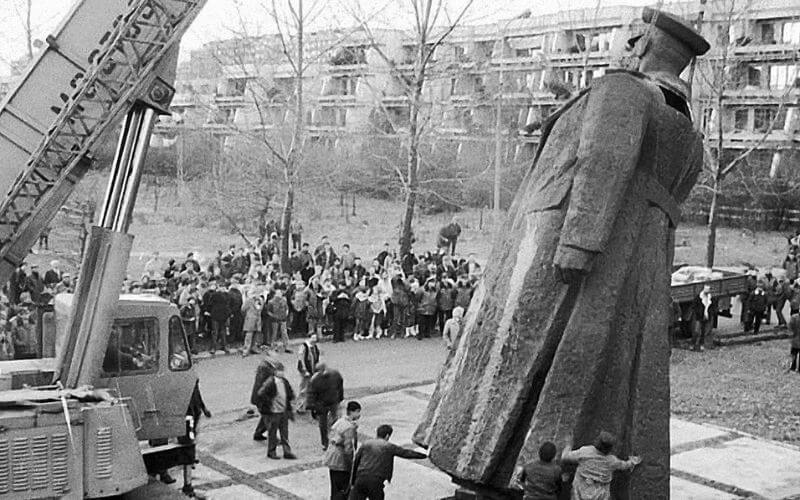
In 1987 he even received his own monument, which stood near today’s fire station on Armii Krajowej Street – only the pedestal remains. The unveiling inspired the “Piwnica pod Baranami” cabaret – the cultural center of the opposition in the Potocki Palace on Kraków’s Main Square – to perform the song “Koniew, Marszałek Koniew wielki jest.” The entire text of a propaganda newspaper article was sung in a solemn, almost lofty style – and the censors could not object, since they had already approved the article.
Konev was lucky: after the political changes, his monument was moved to his hometown, Kirov. A far better fate than the Lenin monument in Nowa Huta, which ended up in an amusement park in Sweden and now sits in storage.
You won’t see these monuments in Kraków anymore, but many others with equally fascinating stories remain. If you’re curious, just let me know https://krakow-tour.pl/en/contact/