Kraków in Two Days – A Weekend Sightseeing Guide
Can you explore Kraków in two days? You can definitely see quite a bit and soak in the atmosphere of this extraordinary place. What’s the most fascinating part of the city of kings? Certainly the Old Town with Wawel Castle and Kazimierz, though that’s not all. Since these places can be explored on foot (or as locals say in Kraków, “on legs”), I’d dare to say you can see a lot in just one weekend. So let’s embark on a two-day journey.
Let’s assume you arrived in the old capital on Friday evening, had a good night’s sleep, enjoyed a tasty and nourishing breakfast, and now have all of Saturday and most of Sunday at your disposal. Of course, the days of the week are symbolic—in Kraków, the weekend lasts all week, at least from spring to autumn.
Kraków in Two Days
Day One – At the Gates of the City
I’d start the tour of the Old Town near the Barbican and the preserved northern section of the city walls. Just over 200 years ago, Kraków had 4 km of walls, 47 towers, and 7 gates. Only one gate remains today—but it’s a remarkable one: the Florian Gate. It was protected by the Barbican, nicknamed the “Rondel,” built over five centuries ago to defend against… the Turks. Where the moat once surrounded the city walls, there’s now a beautiful park—Planty—especially appreciated in summer. It encircles the entire Old Town, from Wawel to Wawel.
Near the Barbican, you’ll also see the Grunwald Monument, unveiled with the patriotic poem “Rota” by Konopnicka, and the statue of Jan Matejko, seated in a picture frame, right next to the Academy of Fine Arts, where he once served as rector.
Interestingly, we’ve already seen so much—and haven’t even entered Kraków yet! How’s that possible? We’re just a few hundred meters from the Main Market Square!
Indeed, dear visitors. The city used to begin at the walls, and only after their removal were suburban towns like Kleparz (where we’re standing) and the better-known Kazimierz incorporated into Kraków.
Day One – Walls and the Lady
Like kings following the Royal Route—which truly passed this way—we enter Kraków through the Florian Gate. From inside, we get a better view of the preserved towers: to the left, the Pasamoników Tower, and to the right, the Carpenters’ and Joiners’ Towers.
We can walk down the bustling Floriańska Street, passing Matejko’s townhouse and the legendary Young Poland café Jama Michalika, or turn right (with the Florian Gate behind us) toward St. John’s Street. If we choose the second option, we’ll see a small but charming overhead passage with the Pogoń Litewska coat of arms. What does Lithuania have to do with Kraków? For centuries, Kraków was not only the capital of Poland but also closely tied to Lithuania, united with the Grand Duchy of Lithuania for hundreds of years.
In this case, the coat of arms belongs to the Czartoryski family—a name every Pole has likely heard. The buildings we see are home to the famous Czartoryski Museum, one of the finest collections in Kraków and all of Poland. Its crown jewel is Leonardo da Vinci’s Lady with an Ermine.
We’ll mention the museum another time, but for now, we peek into the glass-covered courtyard, glance at the copy of the Lady, maybe visit the gift shop for a souvenir featuring her or another Kraków motif, and continue down St. John’s Street to the Main Market Square. And what a square it is!
Kraków in Two Days: The Main Market Square
Arriving at the Rynek Główny (Kraków has more than one market square), we see a spacious plaza—200 meters on each side—making it one of the largest in Europe. It’s surrounded by dozens of townhouses, each with centuries of history. Your eyes will be drawn to the massive building in the center—the Cloth Hall (Sukiennice). As the name suggests, it was once a textile trading hub. Today, it’s filled with souvenirs: sheepskins, folk scarves, crystals, leather slippers, plush toys, and jewelry.
Upstairs is the oldest part of the National Museum, featuring 19th-century paintings, including works by Matejko. Beneath our feet lies a hidden treasure—the Underground Museum, created after extensive renovations between 2005 and 2010. Archaeologists explored every inch—especially downward—and found thousands of fascinating artifacts: coins, everyday items, even anti-vampire burials and the skull of an executed criminal.
If you’d like me to accompany you there, just say the word!
Kraków in Two Days: St. Mary’s Basilica
You can’t miss St. Mary’s Church, whose gem is the altar by Veit Stoss. The master from Nuremberg spent 12 years crafting this monumental piece—the largest Gothic altar in the world. It measures 13 by 11 meters and has two views:
The golden version, with all five wings open, shown on special occasions (though for our guests, it’s opened daily, usually just before noon). The closed version, simpler but still beautiful, used for everyday services.
Interestingly, the original invoice still exists—we know how much the city paid the artist after 12 years of work. And he didn’t work alone, so it was likely just the final installment. Stoss was paid 1,808 florins—the entire annual budget of Kraków at the time!
Now it’s time for coffee—or lunch, depending on how hearty your breakfast was. To be continued…
After a Refreshing Break – What Else to See on the Market Square?
Let’s continue our journey. What else is worth noticing on the Market Square? The small but very old Church of St. Adalbert. This thousand-year-old church stood here long before the Kraków market square was laid out. Interestingly, it used to stand on a small hill. Look at where the original entrance is now—well below ground level. Compared to the 13th century, the level of the market square has risen by 5 to 6 meters!
Kraków in Two Days: Collegium Maius
From the square, we head to the oldest building of Poland’s oldest university—Collegium Maius, just a 2-minute walk away. If you’re still craving coffee, stop by the Pęcherze café and be sure to try their cakes—some of the best in all of Kraków.
Admiring the beautiful Gothic courtyard, you might catch the clock show, which every two hours from 9 AM to 5 PM, accompanied by the student anthem Gaudeamus igitur, presents a procession of figures linked to the founding of the Jagiellonian University.
Walking through the University District, we pass Collegium Novum, and then, returning to the Planty Park, we walk by the Bishop’s Palace with the famous Papal Window—a tribute to John Paul II, who lived there. From here, we head toward Wawel Hill.
Kraków for the Weekend: Wawel
At the end of Planty, the Royal Castle and Cathedral emerge atop Wawel Hill—undoubtedly one of the most important, if not the most important, places in Polish history.
Since the 1930s, Wawel has housed one of the country’s largest art collections, including paintings, textiles, porcelain, sculptures, weaponry, and more. The most precious items are the Arras tapestries—magnificent, multicolored wall hangings interwoven with silver threads. During major ceremonies, they covered entire castle walls. Today, 136 tapestries remain (out of about 160 commissioned by the king nearly five centuries ago!). They were made in Arras, a city in northern France. The largest ones measure 8 by 5 meters.
The tapestries alone would be reason enough to visit the castle. But there’s much more—including Europe’s largest collection of tents, many of which were spoils from the Battle of Vienna in 1683, when King Jan III Sobieski saved the city from the Turks.
Wawel Cathedral, Sigismund Bell, Royal Crypt
While at Wawel, we must visit the Royal Cathedral. Upon entering, we see the sarcophagi of kings on both sides—the last of the Piast dynasty and the first of the Jagiellonians. We descend into the Royal Crypt, where monarchs from Sigismund the Old to the Saxon kings are buried. Since the time of Tadeusz Kościuszko, national heroes have also been laid to rest here, including Prince Józef Poniatowski and Marshal Piłsudski.
We climb the Sigismund Tower, where we admire the 13-ton Sigismund Bell (not “Sigismund’s”!)—the largest manually rung bell in Europe. It takes 12 people to ring it!
After visiting the cathedral, we enter the Arcaded Courtyard—one of the most beautiful examples of Renaissance architecture in Europe. We admire the exterior of the castle, home to Polish rulers for nearly 600 years.
The castle is divided into several exhibitions. More about them in the article: Wawel with a guide.
As it’s now late afternoon, we slowly head off for a good meal, a leisurely stroll around the Market Square or along the Vistula River. And so, day one comes to an end.
Kraków in Two Days
Day Two – Kazimierz – The Jewish Quarter
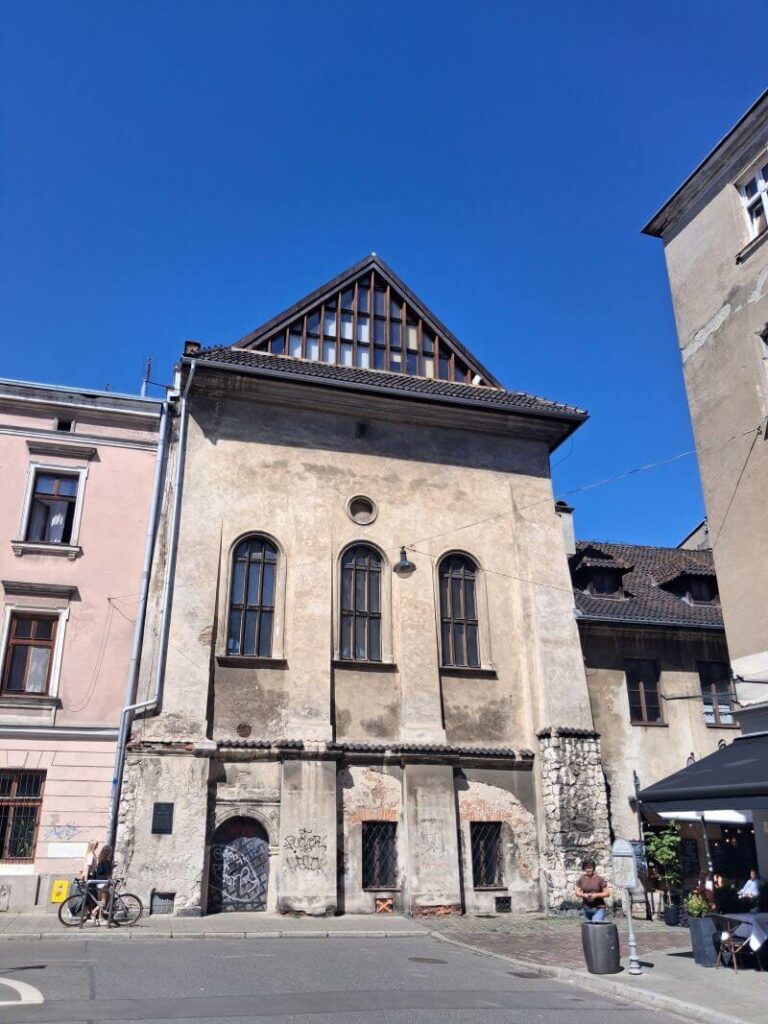
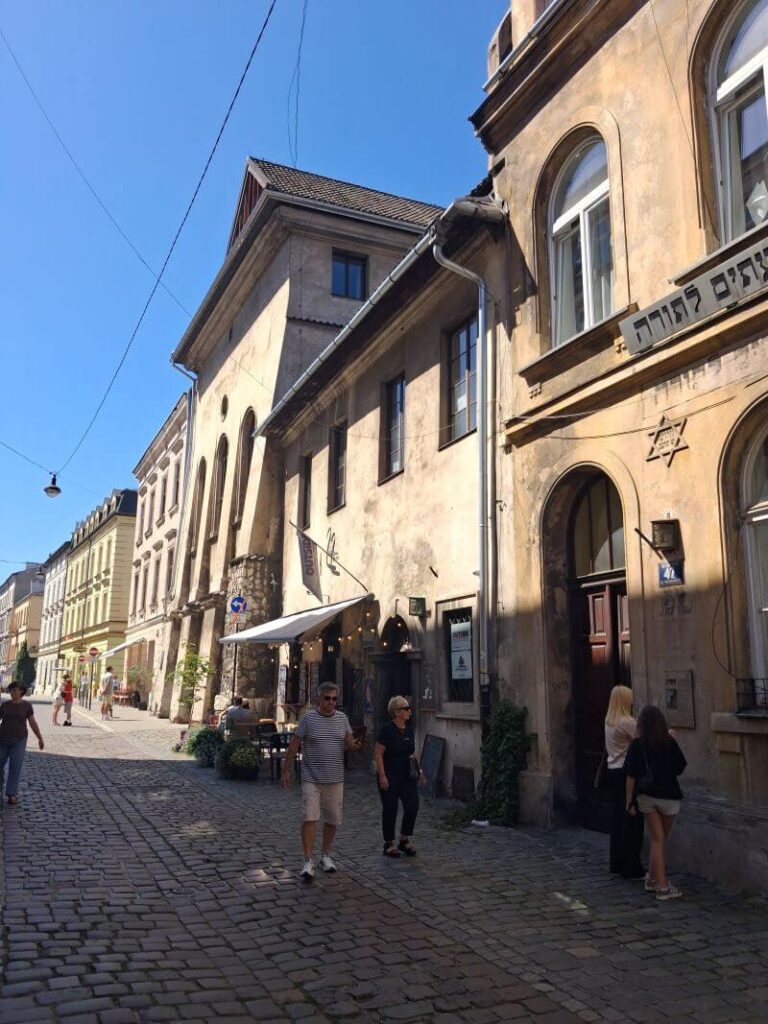
Yesterday we explored a large part of the Old Town. Today we head to nearby Kazimierz, which over 200 years ago was a separate town, founded in the Middle Ages by King Casimir the Great. The town had two parts: Christian and Jewish. Before World War II, there were 90 synagogues here! Most were small prayer houses in larger apartments, but dozens still remain and can be identified and discussed. You won’t find another place like this in Europe.
We begin with the Old Synagogue from the 15th century—the oldest preserved synagogue in Poland. Today, it houses a branch of the Kraków Museum dedicated to Jewish culture. We visit the former Popper Synagogue, walk by the old mikveh building, and see the Remuh Synagogue, named after a great rabbi whose grave behind the synagogue is still a pilgrimage site for thousands of Orthodox Jews each year.
We also see Poland’s largest synagogue—the Isaac Synagogue, whose founder, according to legend, discovered a great treasure hidden in his kitchen. Other synagogues include the Kupa Synagogue and the Tempel Synagogue. We’ll also visit the Jewish Community Center to learn about modern Jewish life in Kraków.
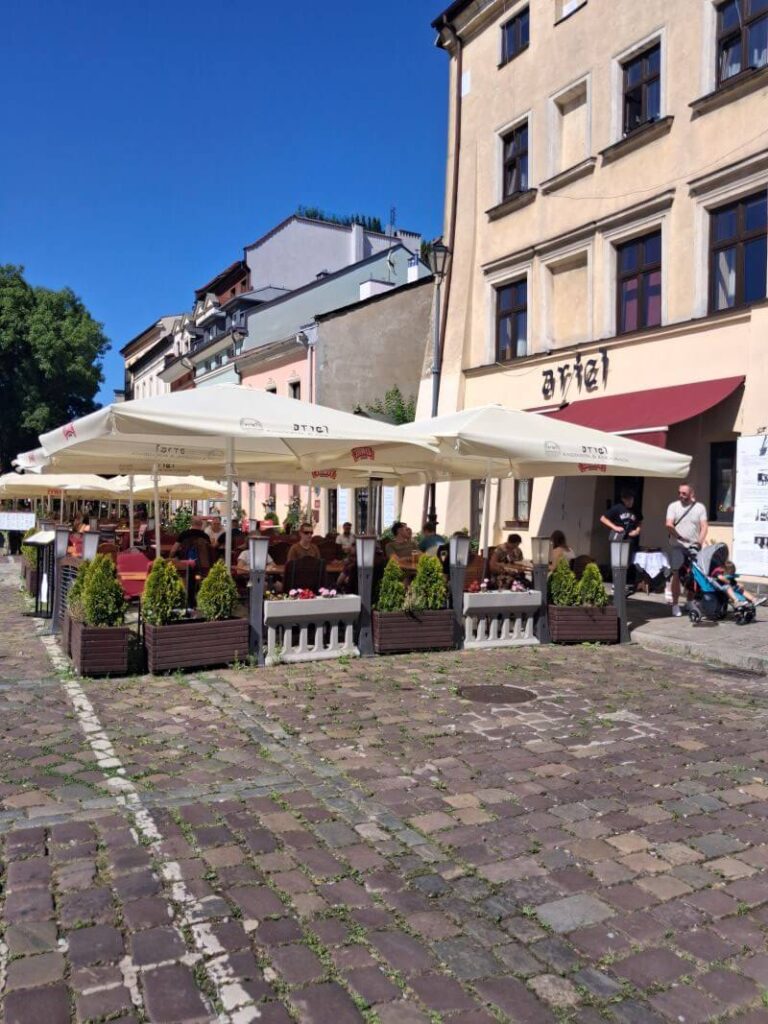
Kazimierz was the filming location for many scenes in Steven Spielberg’s Schindler’s List. The film transformed this previously neglected and rough neighborhood into a vibrant district, perfect for meeting friends for lunch or drinks.
Kraków for the Weekend – Day Two
Podgórze and the Kraków Ghetto
We leave Kazimierz and cross the Bernatek Footbridge over the Vistula River to Podgórze, which over 100 years ago was also a separate town. To the left, we see the fascinating building of Cricoteka—a museum and documentation center dedicated to Tadeusz Kantor. If you’re interested in contemporary art, you should definitely stop by for an hour.
Walking straight from the bridge, we reach Podgórze Market Square, with the beautiful neo-Gothic Church of St. Joseph and the Podgórze Town Hall. Above the church lies the lovely Bednarski Park.
Just behind the square, in 1941–42, was the Kraków Ghetto. The Germans evicted over 3,000 Poles from their homes and relocated around 18,000 Jews here. Unlike the Warsaw Ghetto, which was destroyed after the uprising, Kraków’s—like much of the city—remained largely intact. You can still see fragments of the ghetto wall and the Monument on the Ghetto Heroes Square. A few hundred meters away is Oskar Schindler’s Factory, the site of the famous Spielberg film. Schindler, a German and Nazi Party member, saved over 1,000 lives.
Kraków in Two Days – Day Two
Nowa Huta
Time for lunch—so we hop on a tram or drive, and in 15 minutes, we’re at the heart of Nowa Huta, on Central Square.
Plac Centralny is the showpiece of Nowa Huta, built from scratch in the 1950s by Polish architects and planners. The monumental socialist realist buildings surrounding the square feature Italian-style arcades, Parisian-style windows, columns inspired by ancient Egypt, and beautiful stone cladding—a true example of great architecture.
Walking around, we also see fascinating examples of modernism and postmodernism. But the most interesting aspect of Nowa Huta is its urban planning:
Wide streets, Abundant green spaces
Plenty of shops, clinics, schools, and kindergartens All of this makes it one of Kraków’s most livable districts.
It’s worth visiting the Nowa Huta Reservoir, where you can relax on the beach or breathe in iodine-rich air at the salt graduation tower. Right next to Central Square are the Nowa Huta Meadows, where in the afternoon you can often hear and see pheasants, and on clear days, mountains appear in the distance.
Final Stop
Time to recharge before continuing. Right by Central Square is the Stylowa Restaurant, and on the other side, food trucks—so you won’t leave Nowa Huta hungry.
And just like that, two days have flown by. As you can see, Kraków is well worth a visit—even just for a weekend.
Want to experience the city in a nutshell? Contact a Krakow tour guide today!