Central Square – The Heart of Nowa Huta, Kraków’s Extraordinary District
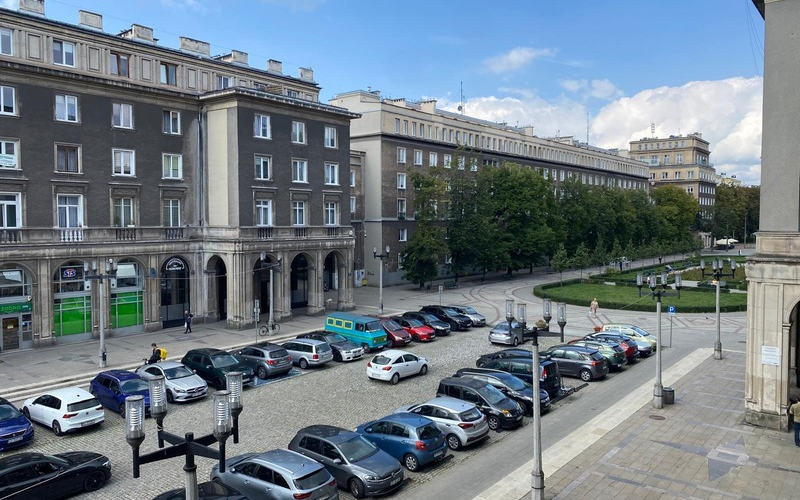
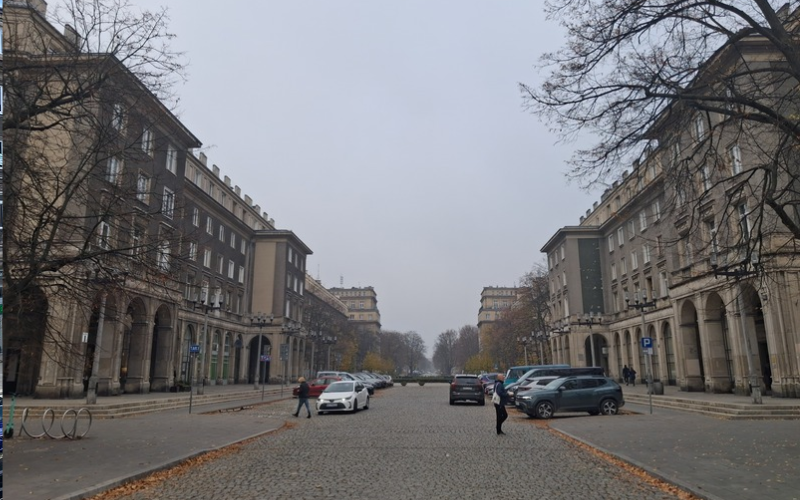
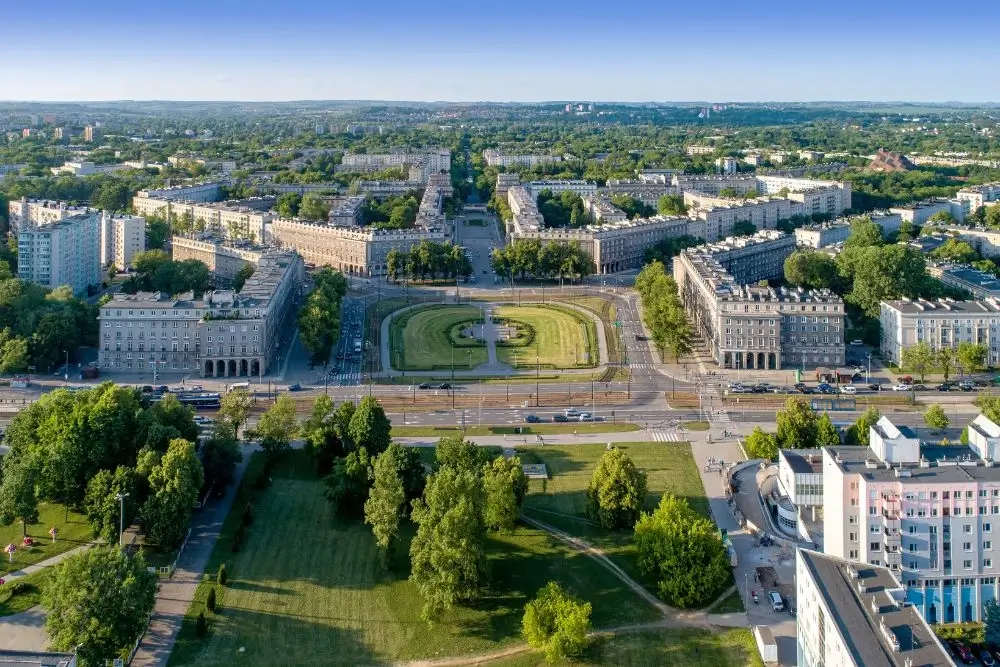
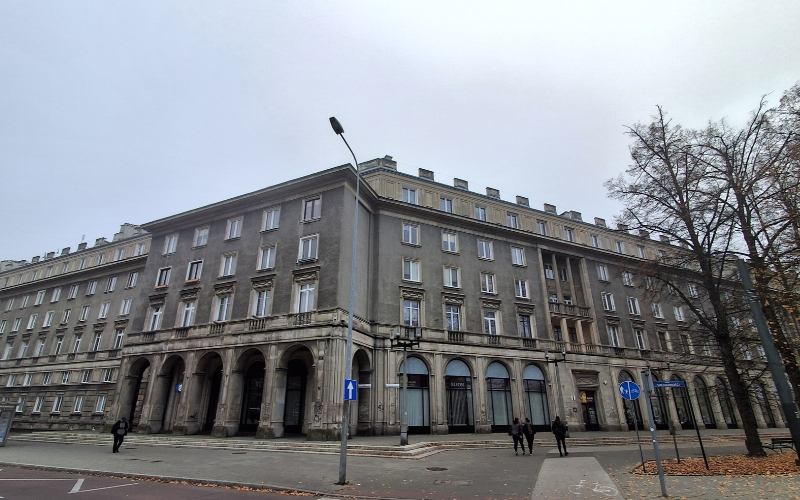
Nowa Huta was built as a showcase of post-war Poland, and its most representative part is Central Square (Plac Centralny), constructed in the Socialist Realist style during the 1950s.
Like many residents of Nowa Huta, I was not born here. I came to Kraków to study in the early 2000s and, although I had been interested in history and architecture since childhood, I imagined Nowa Huta as an unremarkable district of communist-era prefabricated housing estates.
You can imagine my surprise when, one sunny Sunday, I visited the Museum of the People’s Republic of Poland (today’s Museum of Nowa Huta, currently under renovation) and saw solid, monumental buildings clad in stone, lined with arcades, and combining both Polish and Western European architectural influences.
From that moment on, I found myself visiting the area around Central Square more and more often, until I eventually moved here permanently. I have never regretted that decision for a single moment. And since I have worked as a Kraków tour guide for many years, I have had the opportunity to share my fascination with Nowa Huta with visitors to our city.
History of Central Square
The first building in Nowa Huta was completed in the Wanda Estate (Osiedle Wandy) in 1949. A year later, construction began on the focal point of the new planned city: Central Square. The buildings surrounding the square took approximately three years to complete.
These prestigious buildings were designed by a team of architects led by Tadeusz Ptaszycki, along with Adam Fołtyn, Janusz Ingarden and others. For these talented, mostly young architects, Nowa Huta was an extraordinary testing ground and a unique opportunity to spread their wings. After all, how many cities in Europe were built entirely from scratch in the second half of the twentieth century? We could count them on the fingers of one hand.
Interestingly, the architects were supported by interior designers who created furnishings specifically for individual premises, making them unique works of art. Unfortunately, most of these interiors have since been lost or dispersed.
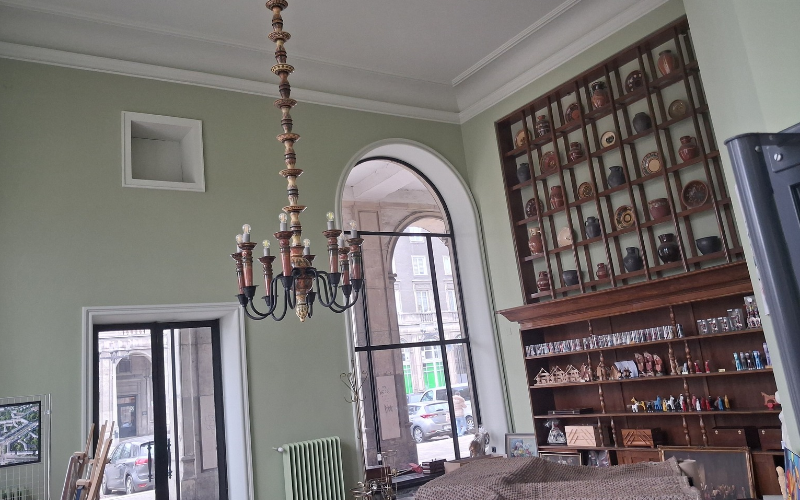
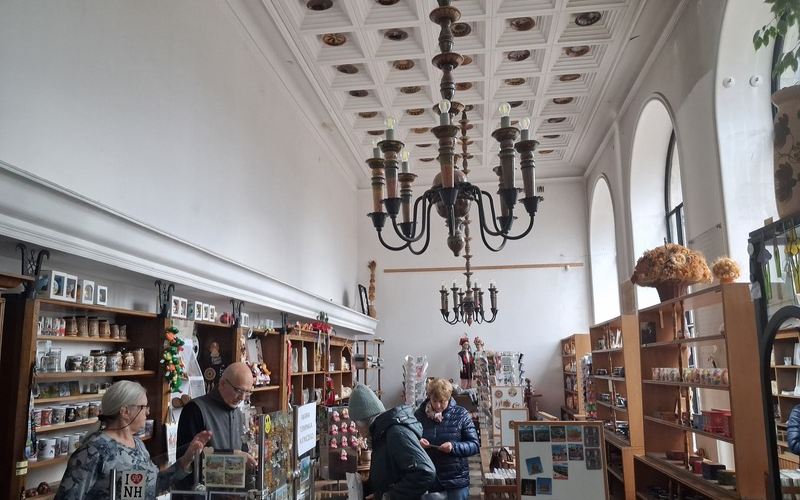
The best-preserved example can be found in the Cepelix shop in Centrum B. Blacksmiths forged decorative grilles, lamps, radiator covers and metal furniture elements. Stonemasons carved decorative balustrades, wall cladding and details from Pińczów limestone, a material that is no longer quarried today. Designers created furniture, chandeliers, shop counters and many other interior features.
The Significance of Central Square in Nowa Huta, Kraków
While guiding visitors from Poland and abroad, I have the opportunity to talk not only about excellent urban planning and architecture, but also about the recent history of this part of Europe, reflected in Nowa Huta as if in a mirror.
Poland is, above all, a story of freedom, and it was for that very freedom that people also fought around Central Square.
A neighbour from my apartment building once told me how her husband had worked in Czechoslovakia on a contract and eventually brought home the long-desired Škoda. At the time, owning such a car could be compared to driving a truly luxurious vehicle today. During the street clashes of the 1980s near Central Square, a riot police flare landed inside their hard-earned car, which burned to the ground. And many people here lost far more than their possessions.
Nowa Huta and Central Square bear witness both to the remarkable reconstruction of Poland from the ruins of war and to the totalitarian era that followed. We must learn from that period if we are to avoid repeating it.
Not far from the square are the Nowa Huta Meadows (Łąki Nowohuckie), an excellent example of how people can live in harmony with nature. You can read more here:
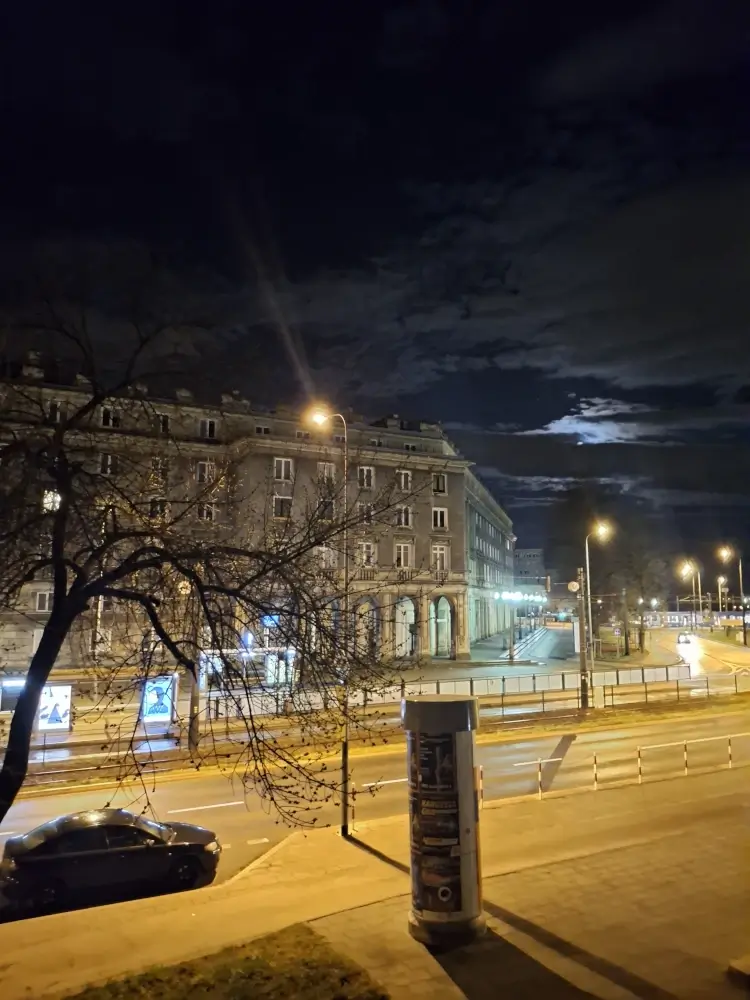
The buildings surrounding Central Square are workers’ apartment blocks dressed in the costume of grand urban tenement houses, often seriously compared to Paris’s Rue de Rivoli. They were built with public funds and were intended to serve not only their residents but also the entire district, becoming its crown jewel.
Architecture of Central Square in Nowa Huta, Kraków
The buildings around Central Square are examples of Socialist Realism, an architectural style that originated in Soviet Russia during the 1930s. After taking power in Poland, the communists imposed the style on their side of the Iron Curtain as well.
It remained Poland’s official architectural style for less than a decade. Following the deaths of Stalin and his Polish counterpart Bierut in the mid-1950s, it gave way to Modernism. Examples of this newer style can be found literally a stone’s throw from Central Square, including the Swedish Block (Blok Szwedzki) in the Szklane Domy Estate and the French Block (Blok Francuski) at Centrum B 8.
Right next to Central Square stands an interesting example of Postmodernism, a style that reached Poland in the 1980s: the Centrum E Estate, designed by Romuald Loegler, whose works also include the Kraków Opera House.
Unfortunately, just as the original Nowa Huta was built during the modest post-war years of the 1950s, the economic crisis of the 1980s prevented many of the planned finishing elements of Centrum E from ever being completed.
You can read more about the district’s remarkable urban planning in the article: https://krakow-tour.pl/en/krakows-nowa-huta-what-makes-it-truly-unique/
Interiors of Commercial Premises Around Central Square in Nowa Huta
Every single commercial premises around Central Square was unique thanks to furnishings and decorative elements designed specifically for its intended purpose.
In most cases, mindless renovations and repeated changes of tenants led to the complete or partial loss of these unique interior features. Yet, as Horace wrote, non omnis moriar – I shall not wholly die. In many cases, parts of the original interiors survived, and in the case of Cepelix, almost the entire interior remains intact.
Until the political and economic changes of the late 1980s and early 1990s, Cepelix was part of the state-owned Cepelia chain (the Centre for Folk and Artistic Industry), which specialised in artistic handicrafts with a strong emphasis on folk art. You could buy, and still can buy despite the disappearance of the original enterprise, wooden toys, handmade dolls dressed in traditional costumes, handwoven wall hangings and similar products. Following privatisation, the shop changed its name to Cepelix, but for more than seventy years it has continued to sell the same kinds of goods.
The first thing that attracts attention upon entering is the series of monumental ceramic chandeliers inspired by folk art. They were created, together with the decorative plates adorning the coffered ceiling, by the now-defunct Kamionka cooperative in Łysa Góra.
Completing the ensemble are sturdy wooden shelves and counters decorated with wrought metalwork, all housed within a six-metre-high interior spacious enough to accommodate a small church.
The interiors of the flower shop at Centrum D 1 are also remarkably well preserved. As far as I know, apart from Cepelix, it is the only premises that has continuously performed its original function.
Next door is today’s Lewiatan supermarket, formerly an Empik store where, during communist times, people could browse foreign magazines and newspapers. It still retains its beautiful gallery above the checkouts and the decorative metal door grilles now displayed near the entrance.
Moving counter-clockwise around the square, the former stationery shop at Centrum C 1 also preserves a fair amount of its original, though more modest, fittings.
Next to it, the restaurant Skarbnica Smaku is an example of positive organic change. It occupies half of the former Skarbnica bookstore while preserving the original style, lamps, radiator covers, balustrades and other features.
Right beside it, however, stands an example of pure barbarism. The pharmacy removed the entire beautiful interior of the former Skarbnica bookstore and replaced it, only a dozen or so years ago, with suspended polystyrene ceilings and shelves made of cheap board and plastic.
At Centrum B 1, a bank now occupies premises that once housed an elegant restaurant. Next door is the already-mentioned Cepelix, and it is also worth taking a look at the solid, well-preserved furniture of the former shoe store behind it. Unfortunately, above it one sees not what were probably handsome original light fittings but spherical lamps characteristic of the 1990s.
Across Solidarności Avenue, formerly Lenin Avenue, lies Centrum A Estate. The former Moda Polska fashion store, now occupied by Rossmann, is yet another example of what can only be described as the passage of the Huns.
One feature worth noticing is the Markiza neon sign from the 1960s, reconstructed several years ago. It originally advertised a confectionery shop. Neon signs have always been an important part of Nowa Huta’s landscape. On the opposite side, at Centrum A 1, there is also the preserved neon sign of the Philatelic Shop, currently undergoing restoration.
As you can see, there is plenty to explore in Nowa Huta even if you focus only on Central Square, and there are many more fascinating places beyond it.
Interested in seeing these and other remarkable places in Kraków with me? Please get in touch: https://krakow-tour.pl/en/contact/