
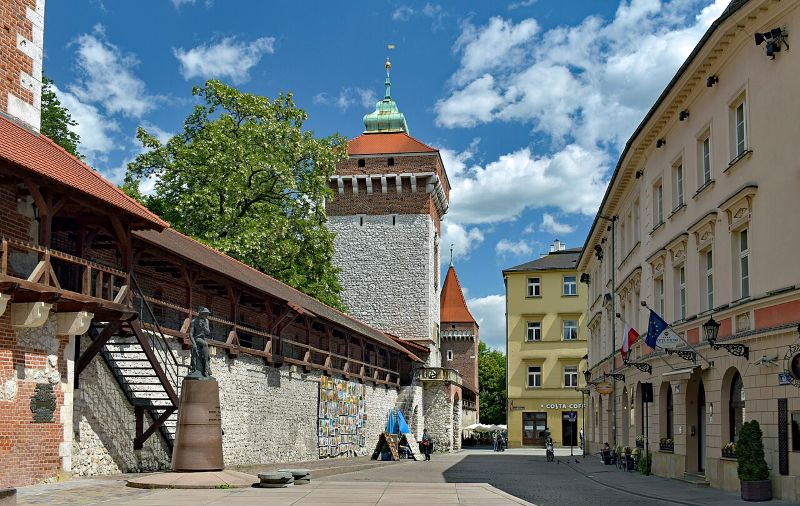
Kraków’s City Walls
When visiting royal Kraków, we see from the north side of the Old Town the Barbican, also called the Rondel, the Florian Gate, and three defensive towers: the Pasamonicy Tower, the Carpenters’ Tower, and the Coopers’ Tower. The walls together with the Barbican can be visited during the summer season, as they are part of the Kraków Museum. However, as we can guess, they are only a small remnant of the fortifications that once surrounded the entire city. So how did it all look originally?
The Kraków Barbican
You probably know the saying: “Under King Olbracht, the nobility perished.” It’s quite an exaggeration — the nobility played an important role in our country even into the 20th century — but there is a grain of truth in it. In 1497, King John I Albert set out for Moldavia, which was already under strong Turkish influence, hoping to place his brother Sigismund (later known as Sigismund the Old) on the throne. Not only did he fail, but our forces suffered such a defeat that a Turkish retaliatory expedition against Kraków seemed possible. That is why, in just one year, a round fortification was added to the existing city walls to protect the northern and only dry approach to the city (the other sides were protected by the Vistula River and wetlands). Barbacans were always built in front of the walls and connected to them.
City Walls Built Against the Tatars
The 13th century was not an easy time in our history. Not only was the country divided among numerous dukes, but it was also a period of external threats. The greatest of these were the Tatars, who under the successors of Genghis Khan attacked Eastern and Central Europe. They came to Polish lands mainly to plunder and burn, but they subjugated Rus’ for centuries, and little changed there in the meantime.
Kraków had the dubious pleasure of experiencing three such invasions: in 1241, 1259, and 1287. Only after the second one were city walls built from the white limestone typical of the region.
Four Kilometres of Walls and 47 Towers!
Defending the city was the duty of the townspeople — essentially the men. Since Kraków had as many as four kilometres of walls, a rational division of responsibility was necessary. Each section of the wall was assigned to a specific craft guild. That is why almost all towers were named after professions, such as the existing Pasamonicy Tower, Carpenters’ Tower, and Coopers’ Tower, as well as many demolished ones like the Knife-Makers’ Tower, the Bellows-Makers’ Tower, the Innkeepers’ Tower, and dozens more.
Feliks Radwański — Defender of Kraków’s Walls and the Creation of the Planty Park
Two centuries ago, it was decided to fill in the moats and demolish the city walls. Maintaining four kilometres of walls with 47 towers was a huge expense for Kraków, which was first under Austrian occupation and later a free city. Art history and monument preservation were still in their infancy. Many medieval buildings were lost due to the activities of so called “wall-breakers.” It must also be said that the walls no longer provided real defence against modern artillery, which could have destroyed them quickly.
The extremely difficult task of saving the city walls was taken up by senator — in today’s terms, a city councillor — Feliks Radwański. He wanted to preserve at least the northern part of the walls, with the Florian Gate and the Pasamonicy, Carpenters’, and Coopers’ Towers. Radwański appealed to historical arguments, but neither six centuries of the walls’ existence nor their value to Polish history seemed convincing. The prospect of removing costly structures and selling the stone and bricks sounded far more appealing than old tales.
Seeing the hopelessness of the situation, Radwański used his final argument… the wind. The wind that usually blows from the north — and which, if the northern walls and the Barbican were removed, would freely sweep through the city. And since at the end of Floriańska Street, which runs straight to the Main Square, stands St. Mary’s Basilica, demolishing the walls would inevitably result in skirts being blown up and the immodest exposure of Kraków’s women’s legs. According to legend, this is what convinced the city councillors to preserve the northern section of the walls along with the Barbican. In place of the demolished walls, outer defences, and moats, a beautiful park encircling the entire Old Town was created — the Planty.
So you’ll never get lost in Kraków’s Old Town — sooner or later, you’ll always reach the Planty.
Interested in exploring Kraków with a guide? Let me know.