Kraków Fortress: The Largest Fortification System in Poland. What Should You See?
Kraków is far more than its iconic Old Town, Wawel Castle and Kazimierz. Hidden among parks, hills and residential districts lies one of Europe’s most impressive military heritage sites: the Kraków Fortress, a vast 19th‑century defensive system built by the Austro‑Hungarian Empire. Many of its forts survive today — some restored, some atmospheric ruins — making Kraków a paradise for history lovers and urban explorers.
Why Was the Kraków Fortress Built? A Brief History
After the fall of the Polish–Lithuanian Commonwealth, Kraków briefly fell under Prussian rule, long enough for them to plunder the royal treasury at Wawel. Soon afterwards the city passed to Austria, then became part of the Duchy of Warsaw in 1809.
The Congress of Vienna sealed its fate: Kraków became the Free City of Kraków, an autonomous state under Austrian and Russian protection. This experiment ended in 1846, when Austria took full control and immediately began fortifying the city. Construction started in 1849 and intensified after Kraków was officially declared a fortress in 1856 .
The Austrians incorporated earlier Polish defenses, including Wawel Hill and the Kościuszko Ramparts. Tadeusz Kościuszko himself had engineering experience — he designed the fort at West Point — and his legacy is still visible in Kraków’s defensive landscape.
The First Forts: The Heart of the Fortress
The inner ring of the Kraków Fortress consisted of forts connected by earthworks. Key early structures include:
- Luneta Warszawska — a reduit fort, about 30 minutes on foot from the Main Square.
- Luneta Grzegórzecka — partially preserved, located near the Vistula.
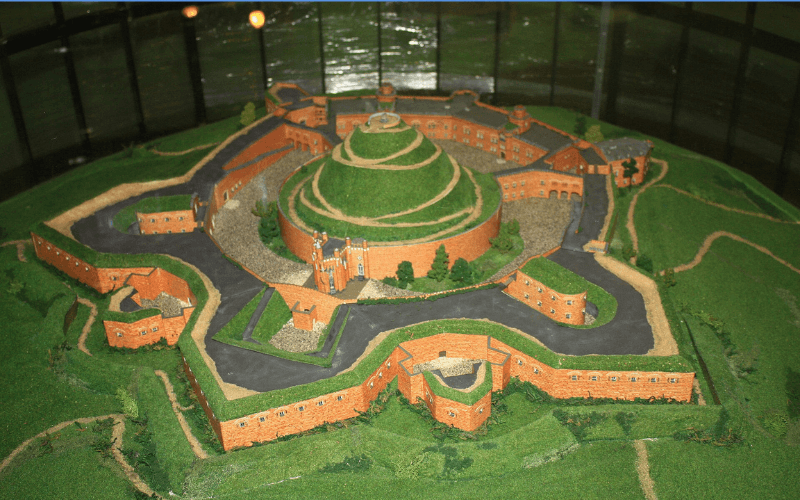
- Fort Kościuszko — the citadel surrounding the Kościuszko Mound, the most iconic element of the entire system.
Some forts did not survive, such as those near Krakus Mound or on Krzemionki Hill. Others remain in excellent condition, including Fort Benedykt, named after the nearby church.
Forts Near the City Centre — Easy to Visit
Many forts lie within walking distance or a short tram ride:
- Fort Kleparz — well preserved; today used for cultural events.
- Fort Lubicz — atmospheric ruins near Mogilskie Roundabout.
- Fort Bronowice (Za Rzeką) — easily accessible by tram.
- Fort Pszorna — remnants in the Polish Aviators’ Park.
- Fort Krowodrza — traces on Krowodrza Górka.
The Outer Ring — Impressive Forts Beyond the Centre
After the Franco‑Prussian War, Austria expanded the fortress with a third defensive ring . Notable sites include:
- Fort Pasternik — Modlniczka (military area).
- Fort Tonie — Jurajska Street.
- Fort Zielonki — in Zielonki.
- Fort Łysa Góra — Węgrzce.
- Fort Batowice — Wawelska Street.
- Fort Krzesławice — site of WWII executions.
- Fort Rajsko — near Droga Rokadowa.
- Fort Borek — Forteczna Street.
- Fort Bodzów — a ruin enriched with rock‑cut caverns once used as shelters and storage.
How to Visit the Kraków Fortress
- On foot: Wawel, Luneta Warszawska — up to 30 minutes from the Main Square.
- By tram: Fort Bronowice, Fort Mogiła.
- By bus: Outer forts such as Fort Bibice.
- Museum access:
- Fort Winnica
- Fort Bielany Both are part of the Kraków Fortress Museum.
With three defensive rings and hundreds of structures, the Kraków Fortress is one of Europe’s largest fortification complexes. It fulfilled its purpose: during the early months of WWI, it successfully halted the Russian offensive.
I would be glad to help you explore Kraków! https://krakow-tour.pl/en/contact/
Fot. Dawid Galus za Wikipedia