
Two Versions of the Legend of the Wawel Dragon and Two Monuments of the Beast
Everyone has heard the legend of the Wawel Dragon – the creature that, centuries ago, long before Poland even existed, terrorized the inhabitants of Kraków. Medieval legends often originated from large bones of extinct animals that were dug up. Since they could not be attributed to any known species, stories about dragons emerged. On Wawel Hill, just to the left of the cathedral entrance, three huge bones hang – said to be dragon bones, but in reality belonging to a whale, a mammoth, and a rhinoceros.
Beneath Wawel Hill, a limestone formation marking the beginning of the Kraków–Częstochowa Jura, lies a cave much larger than one would expect under such a small hill. It is 276 meters long and open to visitors in summer. The entrance is located above the cave on the Vistula side. Interestingly, in the 18th century the cave housed… a brothel.
Two Versions of the Legend
The legend was first written down in the 13th century by the chronicler Wincenty Kadłubek. In his version, the dragon – called “the Devourer” – lived in a cave. Two sons of King Krak, the legendary founder of the city, confronted the beast: Krak and Lech. They placed an animal skin filled with sulfur at the cave entrance. The dragon ate it and died in agony.
After the victory, the younger brother Lech killed Krak to seize the throne and lied that the dragon was responsible. The truth eventually came out, and Lech was exiled.
The second, far more popular version – and the one I personally tell at the end of every Wawel tour – says that King Krak had a single daughter (often identified with Wanda). The dragon demanded a virgin every week; otherwise, he would devour the townspeople and their livestock. The king was heartbroken at the thought of sacrificing his daughter. But on the eve of the offering, a poor young shoemaker (often called Skuba or Dratewka) knocked on the castle door and offered to kill the beast. As in the first version, he filled a sheepskin with sulfur and tar and left it at the entrance to the Dragon’s Den. The dragon devoured the poisoned skin, died, and everyone lived happily ever after.
To this day, Kraków has two early medieval mounds: Krak’s Mound in Podgórze and Wanda’s Mound in Nowa Huta.
Two Monuments of the Wawel Dragon
The most famous monument stands at the exit of the Dragon’s Den. Created in 1972 by Bronisław Chromy, it depicts a bronze dragon on a stone pedestal. Inside is a gas installation that allows the dragon to breathe fire every few minutes. For a while, you could even trigger the fire by sending a paid text message – fortunately, this idea was abandoned.
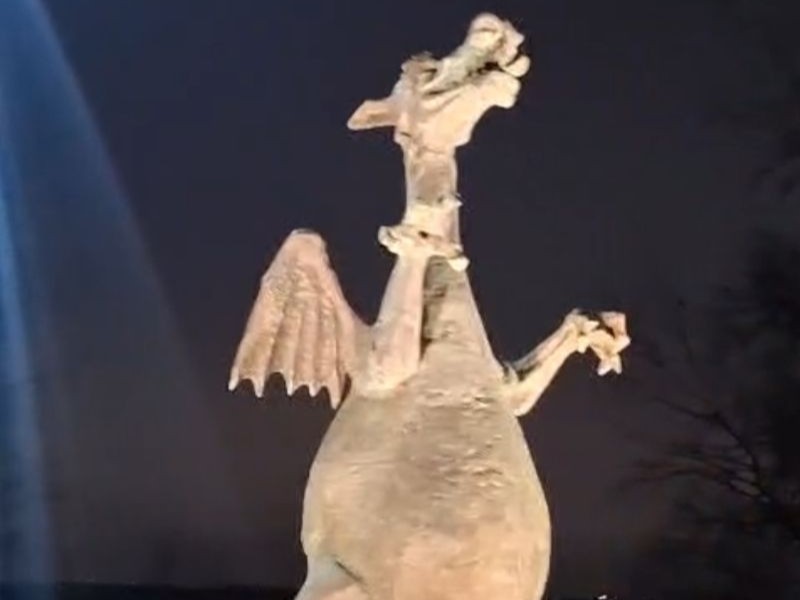
Much less known is the second monument – naturally located in Nowa Huta. It was created around the year 2000 and stood until last year on Kornel Makuszyński Street. The area is not particularly representative, consisting mostly of company buildings. One of the companies, a paving-stone manufacturer, built a demonstration courtyard on its premises. On a pedestal made of paving stones stood a metal dragon. Over the years, both the company and the courtyard deteriorated. The dragon was eventually stolen, apparently by scrap thieves, but luckily recovered, restored, and a few weeks ago placed behind the Nowa Huta Cultural Centre at Ronald Reagan Square.
Recently, small dragon figurines have begun appearing around Kraków, somewhat reminiscent of the Wrocław dwarves. Still, the two monuments described above already have their own noteworthy history.
Would you like to see both Wawel Dragon monuments and many other fascinating places in Kraków’s Old Town, Kazimierz, Podgórze, Nowa Huta, and beyond?
If so, just let me know: contact.