A Naked Woman on St. Mary’s Church – or What Kraków Has to Do with Alexander the Great
“What a horse is, everyone can see,” wrote the 18th century encyclopedist Fr. Benedykt Chmielowski under the entry “horse.” The same could be said about Kraków’s St. Mary’s Basilica. Anyone who has ever been to Kraków’s Main Market Square has seen this massive Gothic structure with its more than 80 meter tower called the Hejnalica, from which the St. Mary’s bugle call is played every hour. More about the bugle call and other curiosities of St. Mary’s Basilica next week. Today, however, we talk about naked women. Seriously!
Phyllis and Aristotle – an Ancient Legend
Alexander the Great, also called the Macedonian, ruler of a vast empire that conquered half the known world from Greece to India, like any self respecting Greek, had both male and female lovers. One of the fortunate ones was a young woman named Phyllis. The king’s teacher was Aristotle, a student of Plato and one of the greatest philosophers of all time; the Catholic Church based its philosophy on him for centuries. The philosopher admonished his royal pupil not to waste time on physical pleasures with his lover but to focus on ruling and matters of state. But he met his match: Phyllis successfully seduced and humiliated Aristotle, proving that theory does not always align with practice.
Phyllis Riding Aristotle – Medieval and Renaissance Depictions
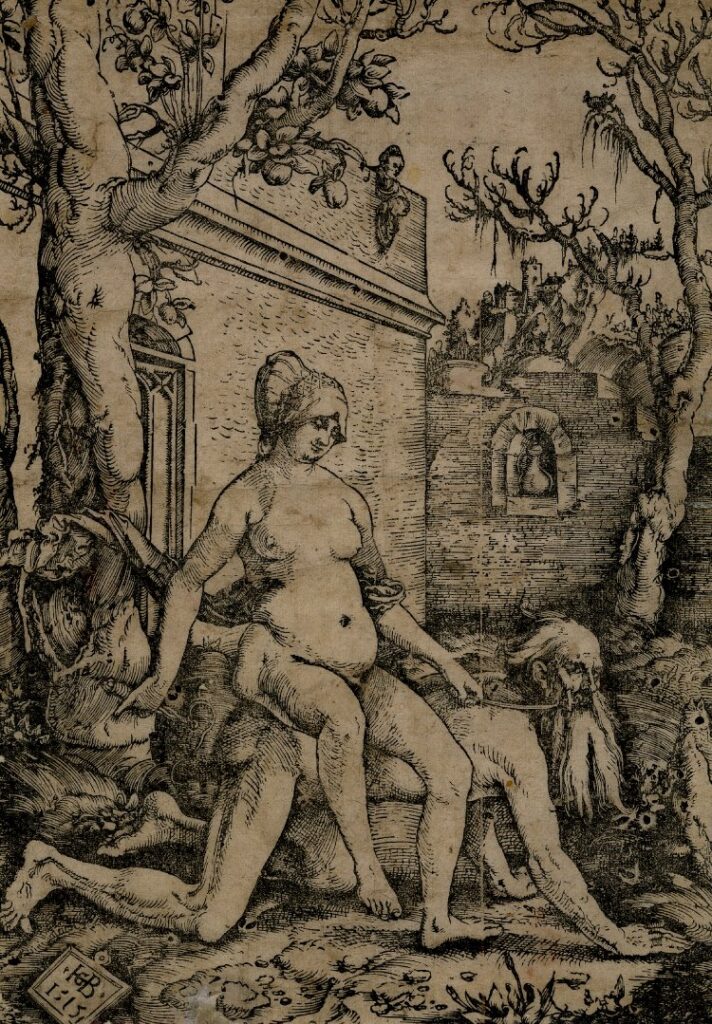
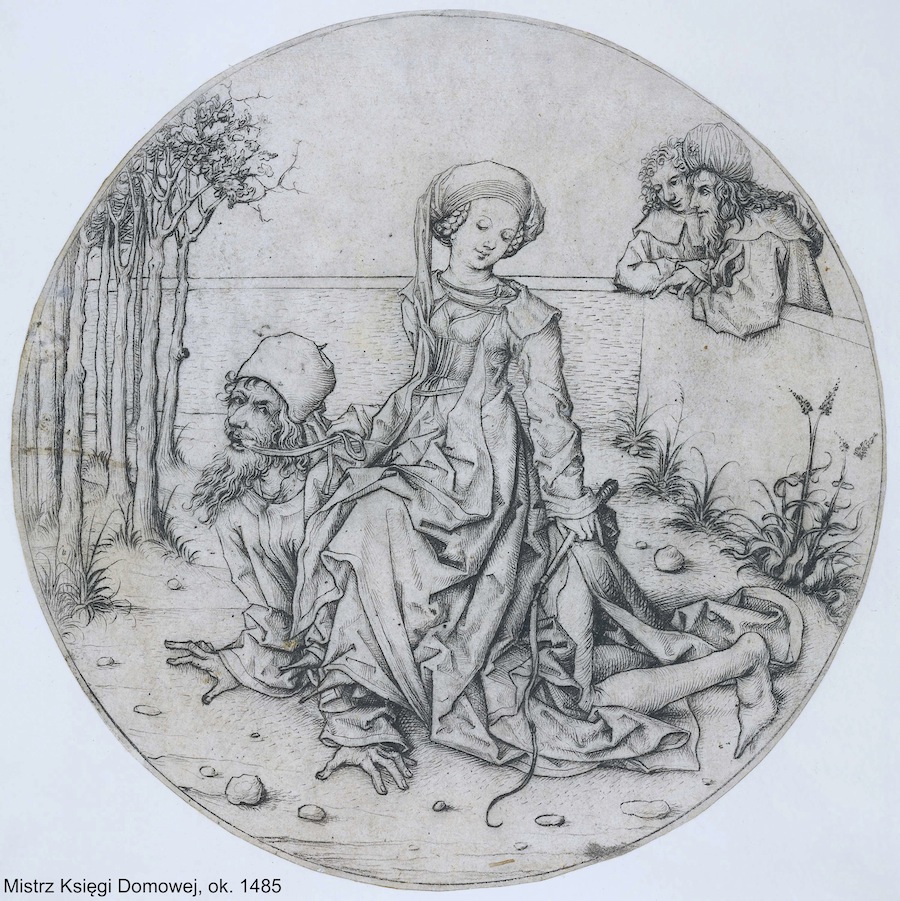
The story of Phyllis and Aristotle appeared frequently in medieval and Renaissance art. Leonardo da Vinci, among others, depicted Phyllis sitting on and riding the philosopher. In some representations, Phyllis holds a whip, while the sage wears a bridle and harness like a horse. Often the philosopher is nude; sometimes both figures are nude.
The story served as an allegory of reason being enslaved by passion and desire, though its erotic—some would say perverse—aspect is undeniable.
Phyllis and Aristotle – A Sculpture on St. Mary’s Basilica in Kraków
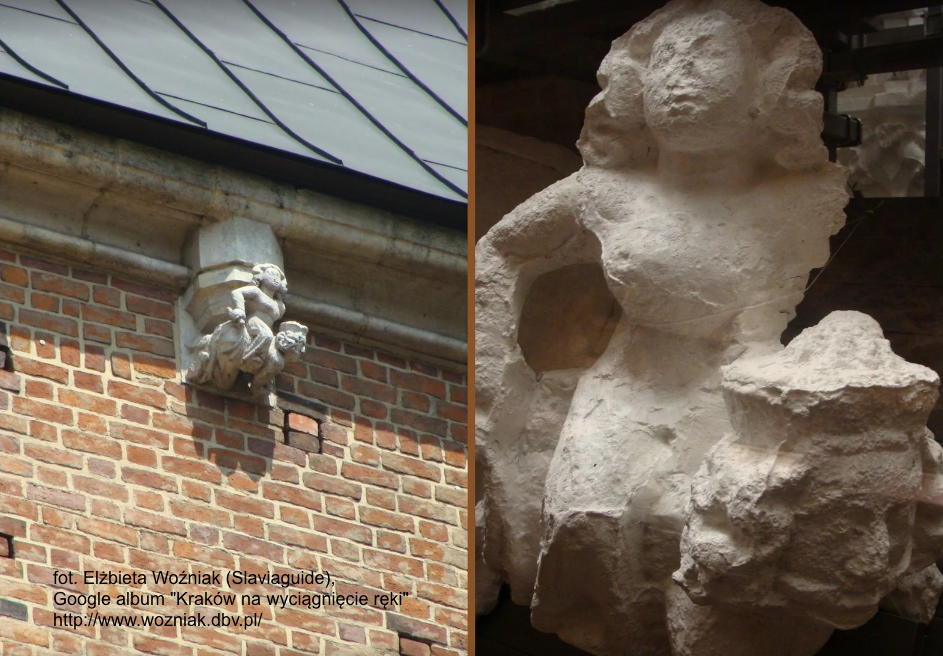
So where is this “naked woman”? On the presbytery—the part surrounding the altar—on the outside, facing Mariacki Square. When we look several dozen meters up at the presbytery, we see carved stone bosses. They are not easily visible from below with the naked eye due to distance and the passage of time, but if we used binoculars, we would see that nude woman sitting on an elderly man.
It is interesting that the Middle Ages, which we associate with strict morality—just a dozen meters below, near the side entrance to St. Mary’s, iron stocks used to publicly shame adulterers have survived—could in some aspects display erotic themes, including ones that many people enjoy yet still label as “perverse.”
What’s Next Week?
Next week we stay with St. Mary’s, but not with the things you can find on Wikipedia—rather a few curiosities about the most magnificent of Kraków’s churches.
Want to visit St. Mary’s Basilica with me? Let me know: contact – Krakow tour guide.