Kraków’s Nowa Huta – what makes it truly unique?
Recently, I wrote a few words about how Nowa Huta came to be and what myths surrounded its beginnings. Continuing this story about Nowa Huta, I’d like to highlight what makes it most exceptional. One undeniable aspect is its urban planning.
Nowa Huta – a testing ground for Polish planners
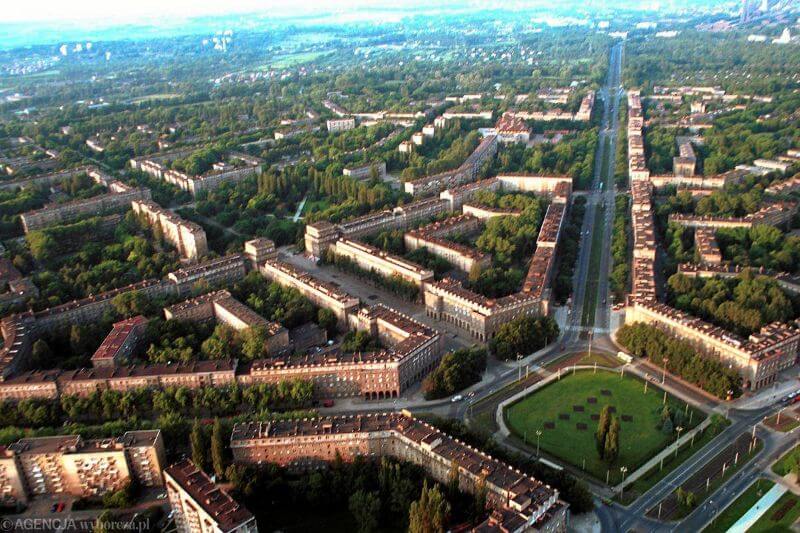
Nowa Huta was planned as a city independent of Kraków. It was built during the deep Stalinist era, so the architectural style was imposed from above. The “old Huta,” meaning the part built from 1949 to the late 1950s, is an example of socialist realist architecture. Because the city was – in theory – being built entirely from scratch, Polish planners were able to implement interesting ideas from 20th century urbanists.
Nowa Huta – the neighbourhood unit
One of the two concepts used in the city’s design was the neighbourhood unit, created by the American urban planner Clarence Perry. Its basic assumptions included a size of no more than a few thousand residents, intended to create the atmosphere of a small town where people know each other and are not anonymous.
The unit was to have its own primary school, kindergarten, medical clinic and shops to ensure autonomy. Main streets formed the perimeter, while internal roads were narrow and pedestrian oriented, eliminating transit traffic.
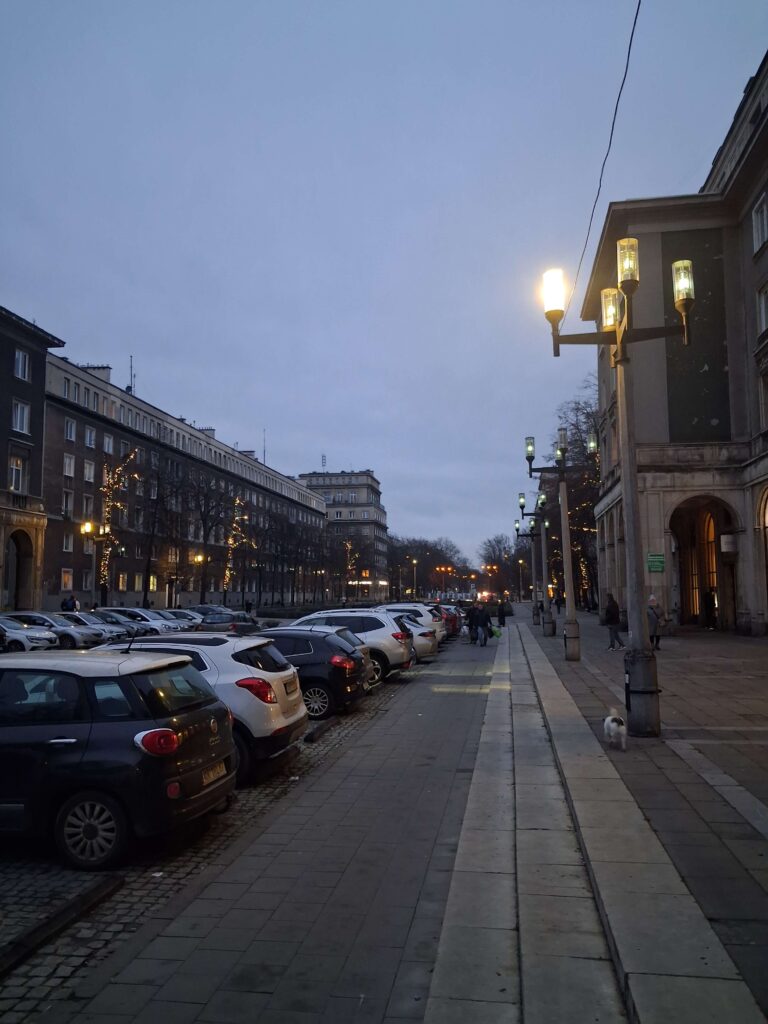
A perfect example of such a neighbourhood unit is the group of estates around Plac Centralny, such as Osiedle Centrum B, where the author of these words has lived for almost a decade. Around it is a ring of shops – from groceries and bakeries to florists, bookstores, a bookbinder and even a luthier! In the centre there is a clinic and a kindergarten. The outer buildings, arranged in a polygon with several entrances, shield the estate from noise and the hustle of the big city. Believe me, it’s a wonderful place to live.
Nowa Huta – the garden city
On the outskirts of the “old Huta,” in estates such as Willowe, Wandy and Sportowe, a second interesting urban concept was applied – the garden city. Its creator was the Englishman Ebenezer Howard.
This concept assumes loose development, buildings spaced apart and surrounded by greenery: squares, parks and green areas. Again, it is meant to be the size of a small town, but not a dormitory suburb of a metropolis. Instead, it was to include industrial facilities on its outskirts. Because the garden city was to be built on agricultural land, housing prices were expected to be low. According to the idea, the creation of a cluster of such garden cities would lead to the formation of new ones. Connected by fast transport, they would be grouped around a larger central city.
What’s in the next post? In the next entry, we’ll chat about interior design and small-scale architecture, which you discover at every step while walking through Nowa Huta.